Collaborative Filtering and Matrix Factorization
For many online services (including E-commerce, online news and social media applications), the secret of recommendation system is in modelling users' preference on items based on their past interactions (such as: ratings, clicks, purchases, likes, ...). It is as known as Collaborative Filtering.
Interaction Matrix.
The matrix shown below is a sample of user-item matrix (or called interaction matrix).
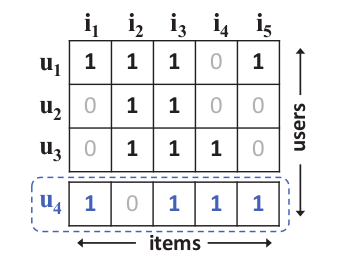
Let's say we have users and items (products). is an interaction matrix from users' implicit data where,
And the problem of Collaborative Filtering is to estimate the unobserved entries (zero values) in the matrix .
Matrix Factorization.
Matrix Factorization is one of the most popular algorithms to solve Collaborative Filtering. Given a parameter , Matrix Factorization converts the matrix to a pair of matrices and where,
- .
- .
- .
Here, is a small positive integer (compared to M or N). And approximates the matrix . Since we reduced many dimensions ( is much smaller than and ), many original information are lost now. The original zero-values become not zeros, and it can be seen as some kind of estimated values showing the hidden trend from the original matrix.
Implement Recommendation using SK-Learn.
For the rest of this article, I'll show an example using scikit-learn to create recommendation result from a movie rating dataset. The data is from Kaggle's The Movies Dataset.
Basically, there are three columns in the given dataset:
userId: integer starting from .movieId: integer starting from .rating: float number, from to .
First, we load the dataset as a pandas data frame.
import pandas as pd

# Load rating dataset.
ratings = pd.read_csv('./data/ratings_small.csv')
And we convert the data frame into a sparse matrix.
from scipy.sparse import coo_matrix

# Create interaction matrix.
def make_interaction_matrix(ratings):

    # Retrieve row indexes (userId starting from 1).
    rows = (ratings['userId'] - 1).values

    # Retrieve column indexes (movieId starting from 1).
    cols = (ratings['movieId'] - 1).values

    # Retrieve implicit values.
    vals = ratings['rating'].values

    return coo_matrix((vals, (rows, cols)), shape=(max(rows) + 1, max(cols) + 1))

# Interaction matrix.
Y = make_interaction_matrix(ratings)
Then we use Scikit-Learn's Non-negative Matrix Factorization implementation to decompose the interaction matrix. Here we choose the vector size to be .
from sklearn.decomposition import NMF

# Create matrix factorization model.
model = NMF(n_components=10)

# Fit the data and retrieve the left matrix W.
W = coo_matrix(model.fit_transform(Y))

# Retrieve the right matrix H.
H = coo_matrix(model.components_)
After that, we use to compute the prediction matrix and extract all the predicted ratings above where it does not exist in observed data.
# Compute the predition matrix.
P = W * H

# Find non-zero ratings in the prediction.
(I, J, V) = find(P >= 2.5)

# Filter predictions where it does not exist in the implicit data.
new_idxes = list(filter(lambda i : ((ratings['userId'] == I[i] + 1) &
                                   (ratings['movieId'] == J[i] + 1)).sum() == 0,
                       range(len(I))))

# Recommandation ratings.
rec_ratings = pd.DataFrame({
    'userId': I[new_idxes] + 1,
    'movieId': J[new_idxes] + 1,
    'rating': list(map(lambda i : P[I[i], J[i]], new_idxes)),
})
Finally, we can use the result rec_ratings as the recommendation for users. Show the top-x results for each user or show all the result for each user ordered by rating.